
Our Manifesto
Following extensive consultations with the animal protection sector in 2023 and 2024, selected experts, people involved in the fields of academia, law and conservation, as well as the Department of Agriculture, Land Reform and Rural Development, the Department of Forestry, Fisheries and the Environment and the Department of Justice and Constitutional Development, the Animal Law Project has developed a manifesto outlining the drivers for change, the values and principles and a mechanisms for a new regime.
Our Submission to the South African Law Reform Commission
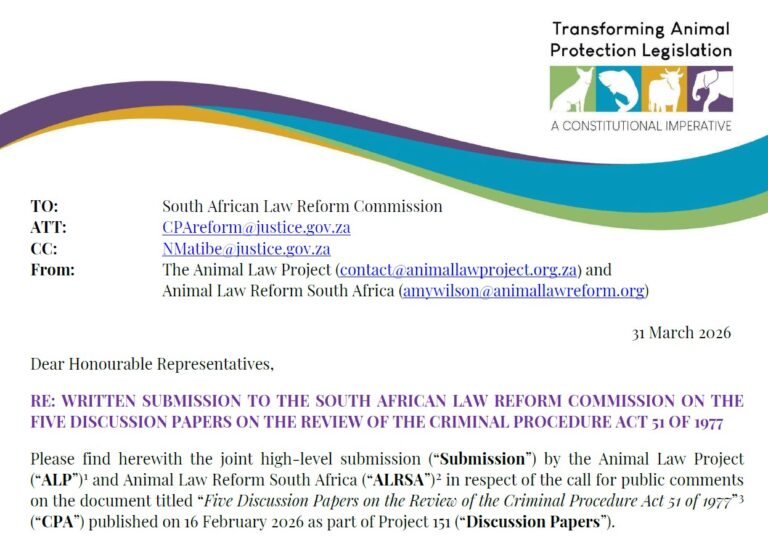

On 30 May 2025, Animal Law Project(“ALP”), Animal Law Reform South Africa (“ALRSA”) and Humane World for Animals (“Humane World”) (formerly, Humane Society International-Africa), made a high-level submission to the Joint Constitutional Review Committee in respect of the call for written submissions on the annual review of the Constitution of the Republic of South Africa, 1996 (“Constitution”) in accordance with section 45(1)(c) of the Constitution.
The submission proposes the explicit inclusion of certain animal protection aspects in the Constitution, including practical matters which affirm the consideration and protection of animal interests as a functional area across all spheres of government.
This submission is not seeking to propose a change in legislative authority over specific legislation, mandates nor jurisdiction. Rather, it seeks a constitutional amendment(s) to explicitly require that, wherever a government function and competency impacts animals, whether directly and/or indirectly, there is a corresponding obligation and duty to adequately consider and provide for their protection.
The submission argues that clarity is urgently needed to prevent the continued marginalisation of animal protection in public decision-making and to ensure accountability (for animals, humans and the environment).
Our Work
Consultations
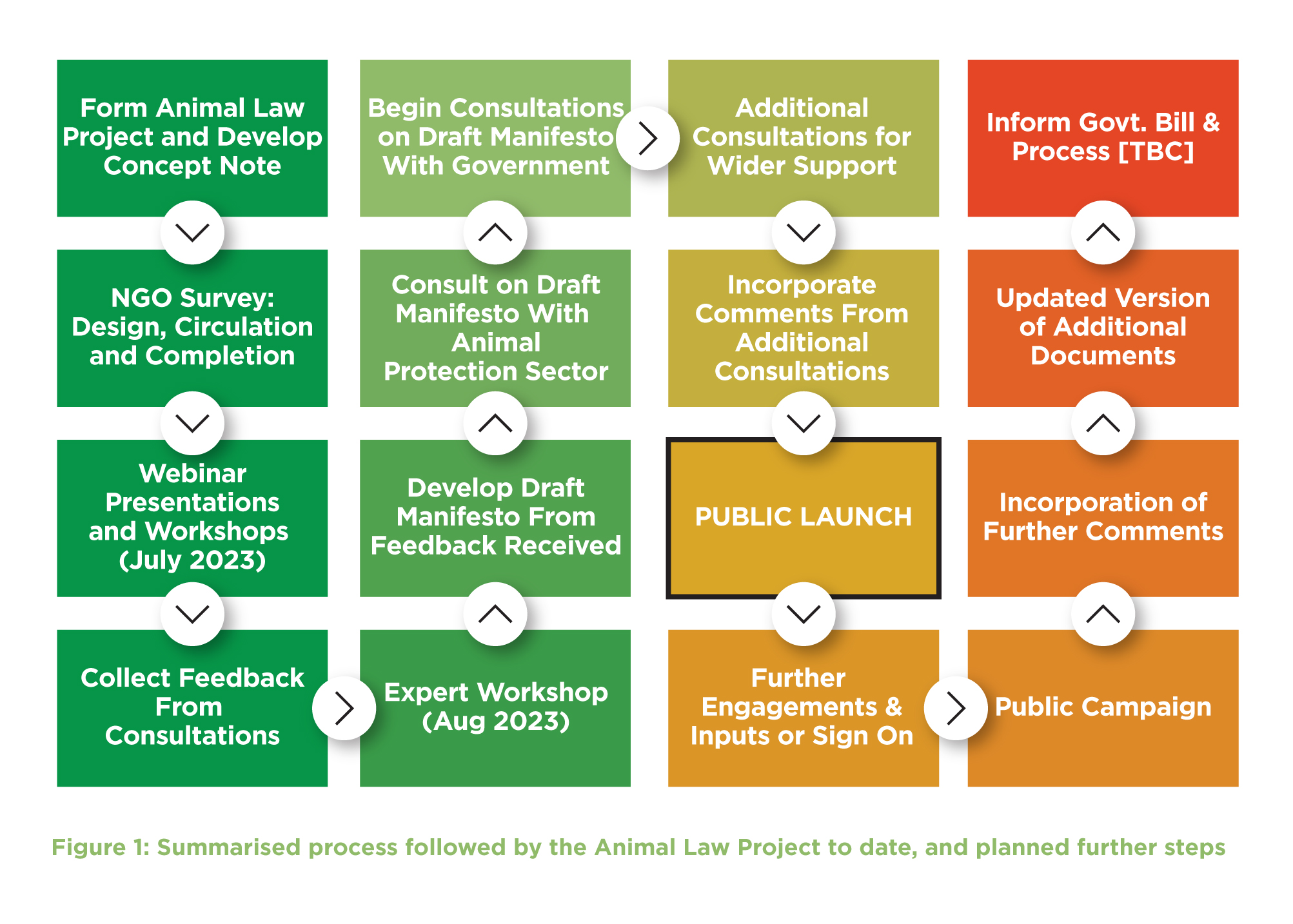
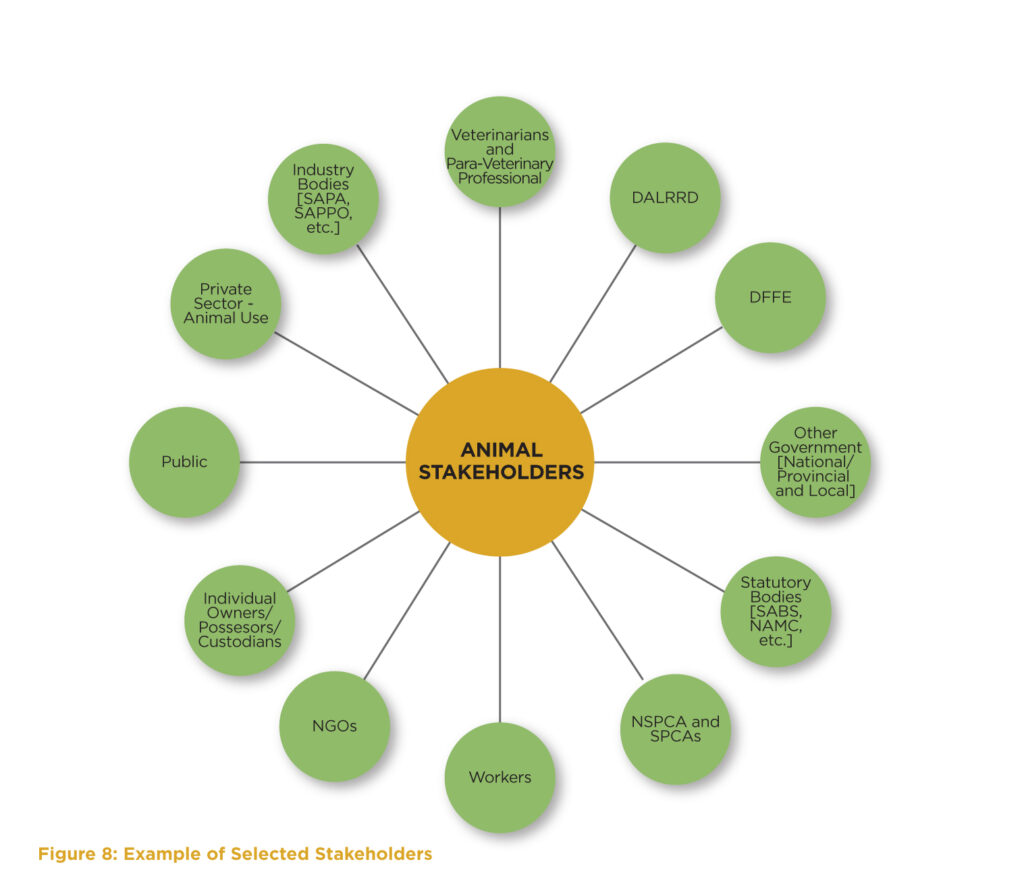
The Animal Law Project has sought to create a platform for the animal protection sector as a whole and other stakeholders to provide feedback on realities and challenges of the current governance regime and to offer inputs as to what they expect from such revised legislation.
NGO Survey
A survey of the Animal Protection Sector was conducted in July 2023 to establish the animal protection sectors’ expectations of the new animal welfare law. The objective of the survey was to identify gaps and future expectation in terms of the government’s role in protecting animals, the South African Regulatory framework, animal law enforcement in South Africa, the drafting of the new animal welfare bill process and expectations from any new animal welfare legislation.
The survey was designed by the Animal Law Project, checked for best practice by Lida Groenewald Research Consultants and hosted on MarkData’s secure platform. The quantitative data was analysed using descriptive statistics and the qualitative data was analysed using thematic content an analysis and included frequency counts.
The survey consisted of 33 questions and took approximately 30 minutes to complete. Of the roughly 600 NGOs (including the SPCAs) who were invited to complete the survey, 73 participated.
Webinar Series for the NGO sector
Webinar 1 Online 12 July 2023
Wild Animals, The Constitution and the Environment
This webinar focused on the Constitutional Impetus for animal protection, the inclusion of animal welfare in the environmental mandate and common law. It also aimed to address the Department of Environment’s mandate for the well-being of wild animals.
Webinar 2 Online 18 July 2023
Companion Animals and Society
This webinar focused on Society and the Intersectionality of animal and human abuse, concentrating on companion animals, enforcement mechanisms and the by-laws.
Webinar 3 Online 21 July 2023
Enforcing Animal Protection Laws and Farmed Animals
This webinar focused on the government mandates of the Department of Agriculture, Land Reform and Rural Development and the SPCA’s, with special attention given to the regulation of farmed animals.
Expert Workshop
A 2-day intensive workshop was held on the 7th and 8th August 2023 in Cape Town, for an expert panel, consisting of experts in the fields of animal law, environmental law, the enforcement of animal law and human rights law. The purpose of the workshop was to build on the inputs received from the survey of the NGO sector and the webinar series and to assist in the drafting of the manifesto.
Broader Consultations
Broader consultations were held with academics, lawyers, conservation organisations, civil society organisations and students on the 19th and 24th of April 2024 at the University of Witwatersrand and the University of the Western Cape respectively.
Consultations with Government
The Animal Law Project presented to the Parliamentary Portfolio Committee of the Department of Forestry, Fisheries and the Environment on the 27th of February 2024.
The Animal Law Project presented to the Parliamentary Portfolio Committee of the Department of Agriculture on the 4th of February 2025.
The Animal Law Project has consulted with the Department of Forestry, Fisheries and the Environment; the Department of Agriculture, Land Reform and Rural Development and the Department of Justice and Constitutional Development.
A New Regulatory Regime for Animals
The Animal Law Project envisages a New Regulatory Regime rooted in the Constitution and based on the foundational principles of Sentience, Intrinsic Value and Constitutional alignment, with a new legal framework premised on 10 guiding principles.


Based on the Foundational Values and Guiding Principles, a Just Animal Protection Regime should provide practical measures, mechanisms and enablers that seek to prohibit harm towards animals which cause suffering and to ensure that those who inflict harm are required to present sound and transparent justification.
The new regime should prescribe standards relating to the care, protection and flourishing of animals including their utilisation and define the responsibilities and obligations of the owners and custodians. It is designed to ensure accountability through the establishment of regulated and prohibited activities as well as associated penalties, remedies and offences, providing a framework for effective enforcement and institutional role clarity.

A project initiated by and in collaboration with
